ANYKS OS
An operating system not written on top of Linux: its own kernel, its own memory model, its own networking and cryptography. Data centres first, then workstations, Elbrus processors and mobile devices.
A “national OS” today means someone else's kernel
Almost everything called a Russian operating system is a Linux build. The kernel is written by thousands of people in another jurisdiction, patches are accepted elsewhere, and the roadmap is set by someone else's community. Swapping one distribution for another changes nothing: the foundation stays the same.
| What exists | Why it isn't enough |
|---|---|
| Astra, RED OS and others | Linux distributions: a foreign kernel |
| Aurora | bought and adapted rather than written |
| KasperskyOS | original and interesting, but adoption is slow |
| Phantom OS | a world-class idea — and development has stopped |
What is open is not the technology but the combination: a system written from scratch, brought to industrial quality and deployed where it is actually needed.
A system that never needs to “save”
The idea comes from Phantom OS, a Russian project where memory survives power-off, program objects live in a managed environment and garbage collection works at the system level. We take the idea and the experience, mistakes included, and write the kernel, drivers, networking, cryptography and graphics anew, to industrial standards.
Power loss
A normal system boots from scratch: load, recover, check. Here work resumes from the same point.
System update
Not “stop, update, start, wait for warm-up”, but continuing with the saved state.
Node failure
Application state is part of the system, not something each application puts into a database itself.
Four steps, not an assault on the desktop market
| Step | What must work | For whom |
|---|---|---|
| 1 · Data centre | kernel, networking, storage, isolation, management, monitoring | data centres, telecom operators |
| 2 · Workstations | graphical environment, browser, documents, mail, printing | organisations required to replace foreign software |
| 3 · Elbrus | native build of the system and applications for the architecture | makers of Russian hardware |
| 4 · Mobile | touch shell, communications, secure exchange | agencies and enterprises with closed networks |
In a data centre the list of required software is measured in dozens, not millions — a new system is complete there from day one. We don't promise to repeat thirty years of the world's software; we cover the list that is vital.
A national processor deserves a national system
Today Elbrus runs a system built on a foreign kernel, and much of the software goes through a compatibility layer. Sovereignty doesn't come in halves: if the processor is ours and the system isn't, independence reaches exactly as far as access to the foreign kernel.
- Native build instead of translation — the system and applications are compiled for the architecture directly.
- Architecture for the compiler — Elbrus shines through ahead-of-time instruction scheduling, and that is a system-level decision.
- Groundwork exists: A-NTS builds with lcc and runs on Elbrus-8C2.
The vital list is finite
For the data centre and developers
- web server and application service
- storage and backup
- databases, logs, monitoring
- compilers, editor, debugger, version control
For the workplace, and a bridge to everything else
- browser, documents and spreadsheets, mail, printing
- POSIX compatibility layer
- running programs in isolation
- porting source by rebuilding
Two works we look up to
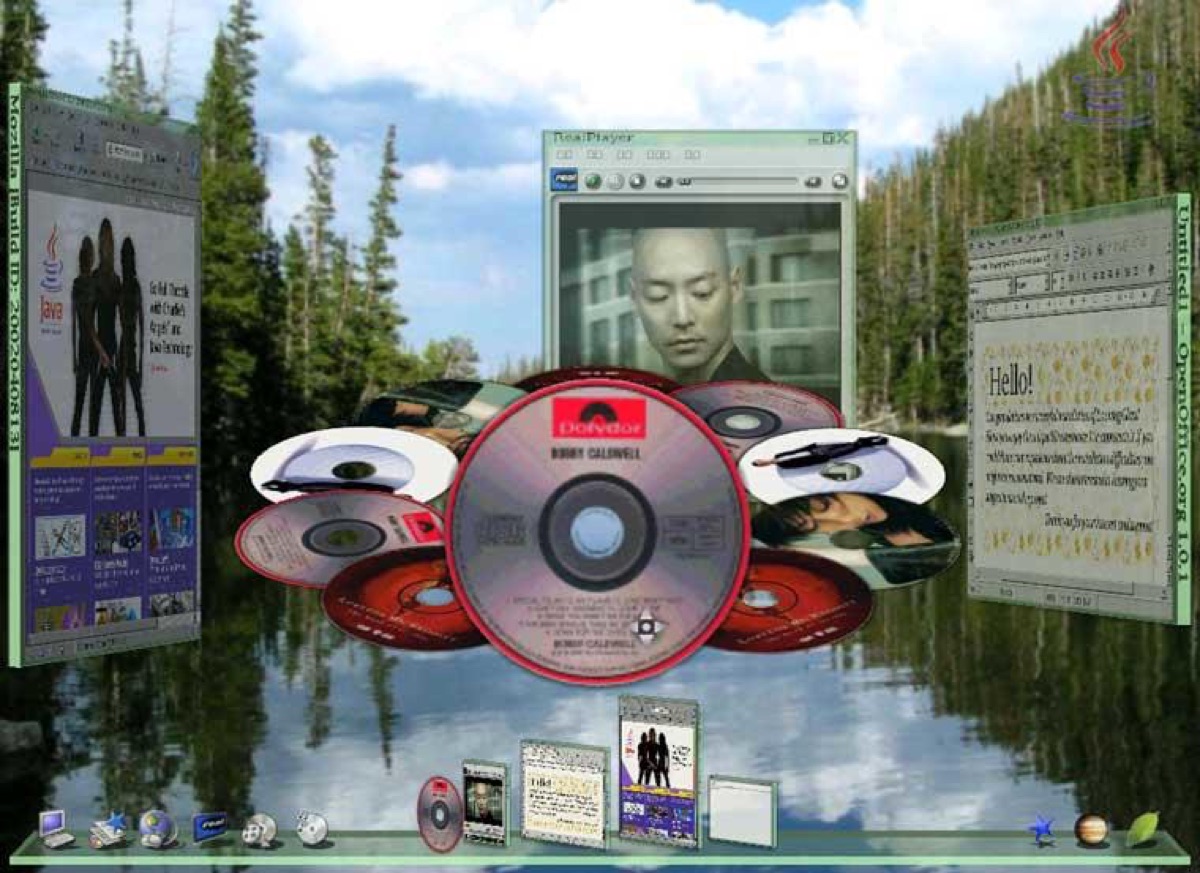
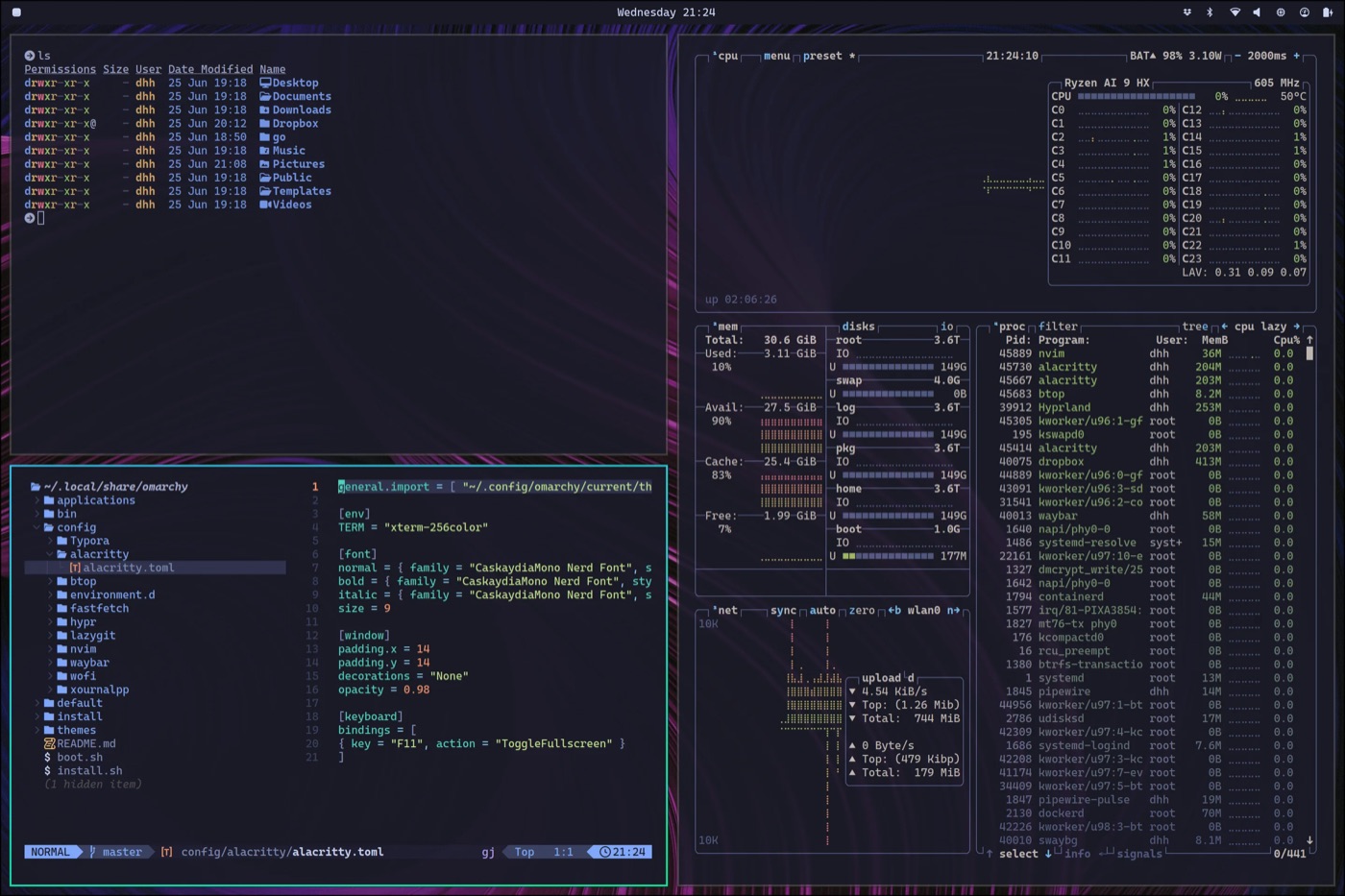
These are not our screenshots. They are two environments that set the direction: the living keyboard-driven Omarchy and the 3D desktop Project Looking Glass, shown by Sun Microsystems more than twenty years ago and never brought to users. We take the approach, not the look.
A workspace you want to work in
A keyboard-driven tiling environment: no dragging windows with the mouse, one consistent look, instant response. For overview and switching — a 3D space where desktops stand in depth.
Terminal
$ anyks statuskernel running · 41 days
memory persistent, snapshot 12 s ago
nodes 18/18 online
network AWH · HTTP/3 · A-NTS
$ anyks restart service.web
state preserved · ready in 40 ms
Monitoring
requests/s 148,200latency 0.42 ms
failures 0
Editor · service.lua
function route(req)return {code = 200}
end
Half of the system is already written
An operating system is more than a kernel: networking, cryptography, storage, data formats, an application runtime. We have all of it — written, measured and running on twelve systems.
AWH — networking
HTTP/1–3, QUIC, DNS, cluster, file system watching
A-NTS — cryptography
our own TLS, GOST, classics and post-quantum
Smart container — storage
snapshots, deduplication, rights and signatures
AWF — application runtime
Python, Lua and TCL with one module set
Usually someone writing their own OS starts from zero and hits networking and cryptography in year three. We start where others stop.